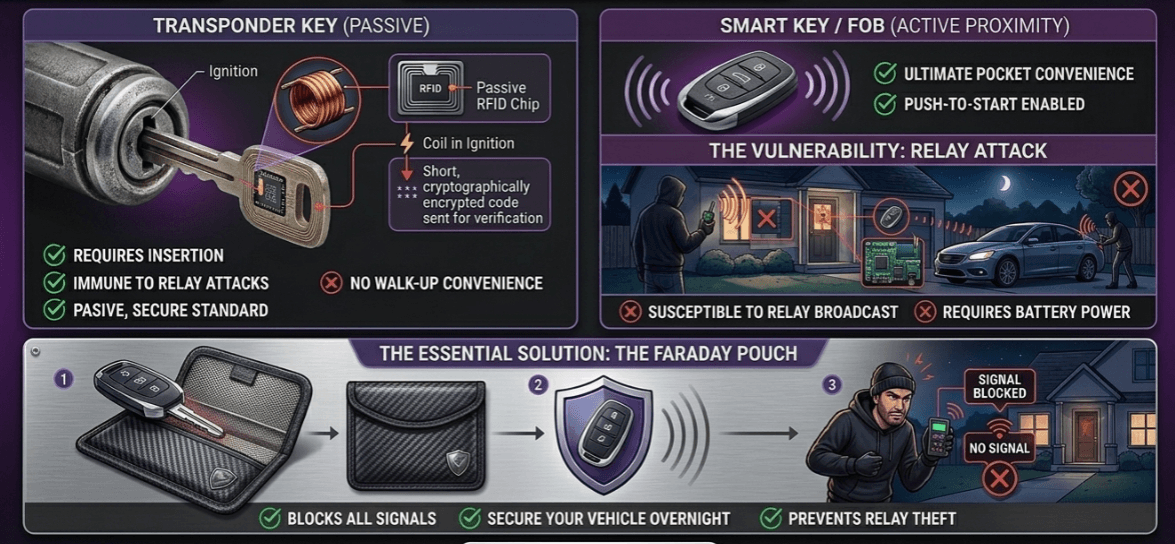

The difference between a "transponder key" and a "smart key" isn't just aesthetic — it's a fundamental shift in how your vehicle validates your identity. One uses passive induction; the other uses active low-frequency dialogue.
The Transponder: Passive Radio Verification
In the 1990s, mechanical keys became "Transponders." If you've ever wondered why a R20 hardware store key won't start your car, this is why. Inside the plastic head is an RFID (Radio Frequency Identification) chip. When you turn the key, an induction coil around the ignition barrel pulses a magnetic field, powering the chip just long enough for it to broadcast its unique 12-digit code.
1995: The RFID Era
Early induction chips introduced to stop "hot-wiring." Mechanical blade still required.
2010: Proximity Start
Keys stay in your pocket. The car constantly "looks" for the key using multiple internal antennas.
The Smart Key: Active Security Hub
A "Smart Key" is essentially an authorized security token that communicates with the car via Low Frequency (LF) and Ultra High Frequency (UHF) radio waves. Unlike transponders, Smart Keys depend on a constant power source (battery) to broadcast their Presence Signal.
The LF Antenna
Responsible for "waking up" the key when you touch the door handle. Operates at a range of precisely 1-3 meters.
Rolling Code Sequence
Prevents signal replay. Every successful authentication advances the key and car to a new mathematical result.
Common Points of Failure
While Smart Keys are more convenient, they are also more fragile. Environmental factors like high-interference zones or even dropping the key can shift the quartz crystal oscillator, desynchronizing the frequency.
- 1Transponder chip failure: Usually from high-impact physical shock.
- 2Smart Key battery death: The car fails to "wake up" the key.
- 3EEPROM Corruption: The immobilizer "forgets" the code after a flat car battery.
- 4Water Ingress: Corrosion on the circuit board creates micro-shorts.
Need Technical Analysis?
Our mobile workshops in Kempton Park carry high-frequency sniffers to diagnose exactly why your key isn't communicating with its transponder. We program both legacy RFID and modern PEPS smart systems on-site.